
Management of Sea Walls and Assets in Chichester Harbour
Chichester Harbour Protection and Recovery of Nature's (CHaPRoN) Coastal Resilience Working Group has developed the following information page on the management of sea walls and assets in the harbour.
Background
Natural England published a review of the condition of the intertidal, subtidal and bird features of Chichester Harbour in 2021, (Condition review of Chichester Harbour sites: intertidal, subtidal and bird features - NERR090). One of the key findings from this review was that the site is in unfavourable declining condition due to ‘Coastal Squeeze’ and ‘inappropriate coastal management’ resulting in the loss of almost half of its saltmarsh since designation of the Site of Special Scientific Interest (SSSI) and a continuing loss of 2.5 ha per year. This loss is occurring because saltmarsh has limited capacity to ‘roll back’ in response to rising sea levels (brought about by climate change) due to fixed sea walls. Where these sea walls are protecting homes and businesses from the risk of flooding, compensation for loss of intertidal habitat is dealt with through the Environment Agency’s strategic Habitat Compensation and Restoration Programme (HCRP), but where sea walls are protecting fields and other areas where there is no direct risk to property, there are also opportunities for allowing that roll-back to occur and to contribute to the recovery of saltmarsh and the environmental, social and economic benefits it provides.
Roles and Responsibilities
There are a number of agencies and organisations involved in the planning and management of the land sea interface around Chichester Harbour. Details of the roles and responsibilities involved in the management of seawalls and assets are provided below.
Private Landowners, Homeowners and Asset Owners
If the coastal defences and land behind are privately owned, maintenance of these defences will be at the discretion of the private landowner. Private landowners have ultimate responsibility for protecting their own property from flooding and erosion but must act within statutory planning regulations and other applicable legislation e.g. Coast Protection Consent under the Coast Protection Act 1949.
Coastal Partners have compiled practical advice about management of flood risk here: Protecting Yourself Against Flooding — Coastal Partners
Environment Agency
The Environment Agency (EA) is responsible for the strategic overview of the management of all sources of flooding and coastal erosion in England. They are tasked with administering grant funds on behalf of the Department of Environment, Food and Rural Affairs (Defra). They are a Risk Management Authority (RMA) and have permissive powers to undertake flood defence works (where there is a wider public benefit, clear economic benefit, and an achievable solution), but there is no legal obligation for the EA to undertake any works to protect property from flooding or erosion.
The EA also has the powers to carry out work to maintain river channels, flood defence assets and structures under their permissive powers and they are provided with funding from Government to carry out this maintenance work. The purpose of the EA’s work is to reduce the risk of flooding to communities from main rivers and the sea. Investment in flood and coastal risk management works is prioritised according to Government policy.
Local Councils: Chichester District Council / Havant Borough Council
The local councils do not have any responsibility or legal obligation to maintain sea walls. They have permissive powers under the Coast Protection Act 1949 to undertake coastal protection works but only where there is a wider public benefit in doing so, such as flood risk to life and property.
County Councils: Hampshire County Council (HCC) / West Sussex County Council (WSCC)
HCC and WSCC Area Access Teams manage Public Rights of Way within these counties.
A summary of the different types of public access paths and the processes for realignment or extinguishment of Public Rights of Way and the King Charles III England Coast Path can be found below:
Chichester Harbour Conservancy
Chichester Harbour Conservancy is a Statutory Harbour Authority responsible for leisure, recreation and nature conservation alongside safe and efficient port management, as set out in the Chichester Harbour Conservancy Act 1971 and management of the Chichester Harbour National Landscape and Amenity Area. Chichester Harbour Conservancy considers all aspects of works undertaken within the harbour, including any interference with public rights of navigation, leisure, recreation and the conservation of nature.
The Crown Estate
The Crown Estate manages approximately half of the foreshore (between mean high water mark and mean low water mark) around England, Wales and Northern Ireland. They also lease and licence tidal land and the seabed for a range of coastal uses including port and harbours infrastructure, moorings, marinas, cables, pipelines and outfalls. The Crown Estate owns significant sections of foreshore and seabed within Chichester Harbour. Areas of Crown Estate owned foreshore can be found here: Foreshore and Estuary Map.
Natural England
Natural England is the Government’s statutory adviser for the natural environment in England and aims to protect and restore the natural world. This is achieved by building partnerships, ensuring nature is integrated into regulation and decision-making to enable sustainable growth and a more secure and equitable future. As an executive non-departmental public body, sponsored by Defra, Natural England are a statutory consultee on planning and licensing matters and have a direct regulatory role in relation to the management of activities on Sites of Special Scientific Interest (SSSIs).
Utility Companies
Protection of utility infrastructure is the responsibility of the relevant asset owners.
Licences and Consents
Any works to sea walls and/or assets may require one or more of the following permissions. Work undertaken without necessary permits constitutes unlawful activity.
An overview of the most common consents, licences and permissions required within Chichester Harbour is proved below (Figure 1).
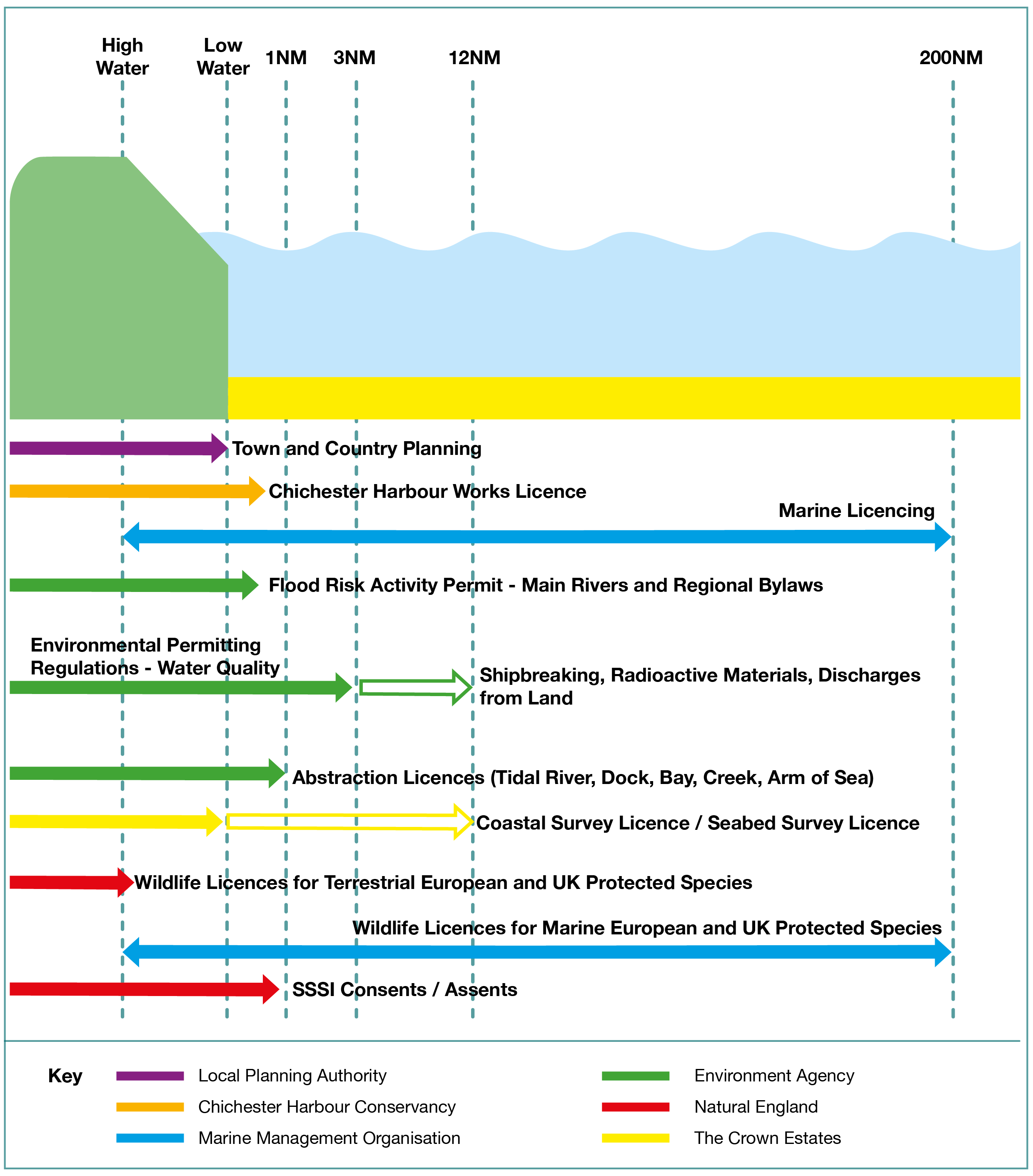 Figure 1: Overview of consents, licences and permissions that may be required for coastal works within Chichester Harbour. Adapted from: A coastal concordat for England: implementation document (updated: December 2019) - GOV.UK
Planning Permission from the Local Planning Authority (LPA)
Any sea wall maintenance or repair works are likely to be exempt from requiring Planning Permission unless the works increase the height or spatial extent of the assets or involve the construction of new structures, however, this should always be confirmed with the LPA Planning Services Team. This falls under the Town and Country Planning Act 1990. If there is a need for Planning Permission, then the Environment Act 2021 places a legal requirement that all developments must demonstrate a minimum 10% Biodiversity Net Gain.
Marine Licence from the Marine Management Organisation (MMO)
If sea wall maintenance or repair works are undertaken by a Coastal Protection Authority, they are likely to be exempt from requiring a Marine Licence, unless the works increase the height or spatial extent of the assets. If the works are not undertaken by a Coastal Protection Authority, the landowner will need to apply for a marine licence by submitting a method statement (and other documentation) which would be assessed by Natural England and other statutory consultees during a formal consultation process. The landowner should check and confirm licencing requirements with the MMO, and can use their interactive assistance tool to support this: Check if you need a marine licence - MCMS Self Service
Site of Special Scientific Interest (SSSI) Assent or Consent
Any sea wall maintenance or repair works within, or adjacent to, the Chichester Harbour SSSI, SAC, SPA and Ramsar site would require a SSSI assent (if submitted by a statutory body) or a consent (if submitted by a landowner), under the Wildlife and Countryside Act 1981 (W&CA as amended). The application would need to include a Habitat Regulations Assessment (HRA), as required under the Conservation of Habitats and Species Regulations 2017 (as amended). As a “Section 28G body” under the W&CA, Chichester Harbour Conservancy is able to provide assent to undertake works on land that it owns within the harbour, if those works fall under its statutory duties under the Chichester Harbour Conservancy Act 1971. For works on land owned by other organisations or individuals, SSSI assent or consent is required from Natural England.
There is a legal requirement that any works should avoid unacceptable damage to the designated sites. For any seawall repairs in the harbour that ‘hold the line’ of the defence, the HRA would conclude that the works would have an adverse effect on the harbour’s designated sites, because they would prevent natural roll-back occurring and prevent the recovery of saltmarsh and the environmental, social, and economic benefits it provides. This would result in a loss of saltmarsh within the harbour, and adverse effects on the SAC and Ramsar designated habitat. Qualifying bird features of the SPA and Ramsar sites would also be indirectly affected through loss of feeding and roosting habitat, which could undermine the conservation objectives of these protected sites.
Therefore, such works can only be approved if it can be demonstrated that there are no alternative solutions that are less damaging to the intertidal habitats in the harbour and make a case that there are imperative reasons of overriding public interest due to there being a direct flood / erosion risk to homes and property. If there are alternative solutions that would not have an adverse effect on the protected sites within the harbour, then these should be taken forward.
If there are no alternative solutions, then works may only be permitted if there are imperative reasons of overriding public interest, such as direct flood / erosion risk to homes and property, and compensatory saltmarsh habitat must be provided.
SSSI permission to repair a seawall where there are alternative solutions, would therefore not normally be given but temporary repairs may be approved on a case-by-case basis only where there are longer term plans in place to enable roll back. Natural England is working closely with partners across Chichester Harbour to take forward these opportunities as a contribution towards the recovery of habitats and species and enabling their ability to adapt to climate change.
Note: SSSI Assent/Consent is not required if Planning Permission or a marine licence has been granted for the works.
Further information for public bodies on SSSI assents can be found here: Give notice and get assent for a planned activity on or near a SSSI - GOV.UK
Further information for landowners on SSSI consents can be found here: Give notice and get consent for a planned activity on a SSSI - GOV.UK
Chichester Harbour Conservancy Harbour Works Licence
A Harbour Works Licence is required to construct, alter, renew or extend any works on, under or over tidal waters or tidal lands below the level of Mean High-Water Springs in Chichester Harbour. This is a requirement of the Chichester Harbour Conservancy Act 1971. Further information can be found here: Works_Licence_Guidance_Notes_and_Application_Form_2025.pdf
Environment Agency Flood Risk Activity Permit (FRAP)
Work to sea walls or assets are considered a regulated activity, requiring a permit from the Environment Agency, under the Environmental Permitting Regulations 2016. A Flood Risk Activity Permit is required if you want to do work on or near a main river, on or near a flood defence structure, in a flood plain or on or near a sea defence. The location of main rivers can be found here: Statutory Main River Map
- Permission is required for the following flood risk activities and developments that occur around the coast:
- dredging, raising or removing any material from a main river, including when you are intending to improve flow in the river or use the materials removed
- diverting or impounding the flow of water or changing the level of water in a main river
- any activity within 8 metres of the bank of a main river, or 16 metres if it is a tidal main river
- any activity within 8 metres of any flood defence structure or culvert on a main river, or 16 metres on a tidal river
- any activity within 16 metres of a sea defence structure
Further information and the full list of flood risk activities that require permission can be found here: Flood risk activities: environmental permits - GOV.UK
Coastal Survey Licence / Small Works Licence from The Crown Estate
The Crown Estate provides permissions for activities that physically interact with the nearshore and seabed of tidal rivers, estuaries and harbours within their ownership. Further information can be found here: Coastal survey licences | The Crown Estate and areas of Crown Estate owned foreshore can be found here: Foreshore and Estuary Map
Historic England Heritage Consents
Permission is required to do work on a site of historical importance. Further information can be found here: Heritage Consents | Historic England
Wildlife Licences
Any work that might disturb protected species will need a Wildlife Licence. Further information on Wildlife Licences can be found here: Wildlife licences: when you need to apply - GOV.UK
Additional Information
Further information on licences and consents can also be found on the Solent Forum webpage here: Solent Forum - Section 2. Consents for Coastal Development and Works